Anthropology, Ecology, and Anarchism by Morris Brian
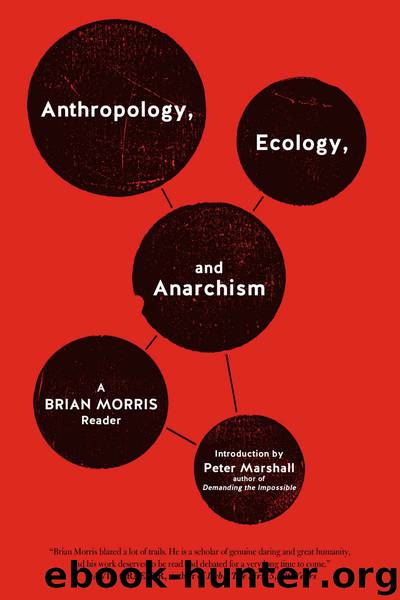
Author:Morris, Brian
Language: eng
Format: epub
Publisher: PM Press
Published: 2014-11-27T16:00:00+00:00
Matriliny and Mother Goddess Religion
The notion that “matriarchy” was an original form of social organisation was a central doctrine of many early anthropologists. The writings of Jacob Bachofen (1967) on classical mythology and religion were particularly influential. Bachofen suggested that “all civilisation and culture are essentially grounded in the establishment and adornment of the hearth,” and that “matriarchy” was an intermediate cultural stage in the development of human society, between hunter-gathering and the rise of the city-state. It was associated with the development of agriculture, mother-right (which did not necessarily imply the political domination of women), reciprocal rather than a Promethean attitude towards nature, and a religious system that emphasised human’s dependence on the earth, expressed through chthonic deities. But although Bachofen suggested that at this stage of human evolution women were “the repository of all culture,” he also emphasised that in all the classical civilisations—Egypt, Greece, Rome—an intrinsic relationship existed between “phallic” gods like Osiris—associated with water as a fecundating element—and female deities like Isis which were equated in myth with the earth, even though the latter were given prominence. Whenever we encounter matriarchy, Bachofen writes, we find it bound up with “chthonian religions,” focused around female deities (88). He also makes the interesting observation that whereas the transience of material life goes hand-in-hand with matrilineal kinship, “father-right” is bound up with the immortality of a supramaterial life belonging to the “regions of light.” With the development of patriarchy in the classical civilisations of Egypt and Greece, “the creative principle is dissociated from earthly matter,” and comes to be associated with such deities as the Olympian gods (129). With the “triumph of paternity,” humans are seen as breaking the “bonds of tellurism” (earthly life), and spiritual life rises over “corporeal existence.” The “progress,” as Bachofen views it, from matriarchy to patriarchy is thus seen by him as an important “turning point” in the history of gender relations (109).
The writings of Bachofen have had an enormous influence. Engels considered his discovery of matrilineal kinship—the original “mother-right gens”—as a crucial “stage” in human evolution; as on par with Darwin’s theories in biology. In an often quoted phrase Engels suggested “the overthrow of mother right was the world historic defeat of the female sex” (1968, 488). Feminist anthropologists who have been influenced by Engels—such as Reed, Leacock, and Sacks—have thus strongly argued against the idea that the subordination of women is universal. They suggest that women have been significant producers in virtually all human societies, and that in many societies—particularly matrilineal societies—women have shared power and authority with men. Their activities were not necessarily devalued, and women often had a good deal of social autonomy, that is, they had decision-making power over their own lives and activities (Sacks 1979, 65–95; Leacock 1981, 134).
Anthropological and historical studies in recent decades have indicated the complexity and diversity of human cultures, and they have questioned whether “matriarchy” (however conceived) can be viewed simply as a “cultural stage” in the evolution of human societies. Yet in various ways Bachofen’s bipolar conception of human history still has currency.
Download
This site does not store any files on its server. We only index and link to content provided by other sites. Please contact the content providers to delete copyright contents if any and email us, we'll remove relevant links or contents immediately.
Spell It Out by David Crystal(36104)
Life for Me Ain't Been No Crystal Stair by Susan Sheehan(35791)
Cecilia; Or, Memoirs of an Heiress — Volume 1 by Fanny Burney(32533)
Cecilia; Or, Memoirs of an Heiress — Volume 2 by Fanny Burney(31931)
Cecilia; Or, Memoirs of an Heiress — Volume 3 by Fanny Burney(31920)
The Great Music City by Andrea Baker(31905)
Professional Troublemaker by Luvvie Ajayi Jones(29644)
We're Going to Need More Wine by Gabrielle Union(19023)
The Secret History by Donna Tartt(19007)
Twilight of the Idols With the Antichrist and Ecce Homo by Friedrich Nietzsche(18610)
All the Missing Girls by Megan Miranda(15901)
Cat's cradle by Kurt Vonnegut(15312)
Pimp by Iceberg Slim(14470)
Bombshells: Glamour Girls of a Lifetime by Sullivan Steve(14041)
For the Love of Europe by Rick Steves(13836)
Talking to Strangers by Malcolm Gladwell(13335)
Norse Mythology by Gaiman Neil(13324)
Fifty Shades Freed by E L James(13218)
The Social Justice Warrior Handbook by Lisa De Pasquale(12178)
